
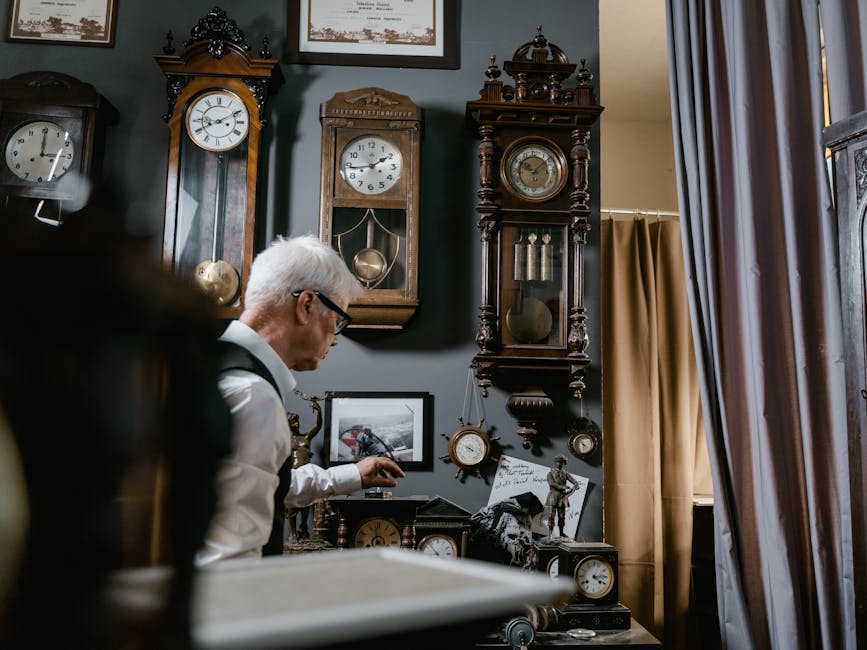

I've been asked many times what makes clock restoration different from other mechanical work. The best answer I've found is that clocks are patient. They'll wait for you to understand them, and they'll tell you what's wrong if you learn to listen.
That sounds a bit mystical for what is, at heart, a mechanical device. But there's truth in it. A clock that stops running is trying to communicate something. Your job as a restorer is to figure out what.
Understanding what you're working with
Before attempting any repairs, spend time understanding how mechanical clocks work. The principles are consistent across most antique clocks, even though the appearances vary enormously.
Power comes from either weights or springs. Weights provide constant force through gravity, which is why longcase and wall clocks use them. Springs store energy when wound, which is more practical for portable timepieces. A series of gears, the gear train, transmits this power while reducing speed. The escapement converts continuous power into the regulated tick-tock that makes a clock a clock rather than just a spinning mechanism. And a pendulum or balance wheel regulates the whole system, its length or tension determining how fast time passes according to that particular machine.
None of this is complicated once you've seen it in action. Take the back off a clock and watch it run. Follow the power from source to escapement. Understand the cause and effect. It becomes intuitive with practice.
Tools and workspace
Clock restoration doesn't require expensive equipment. Precision screwdrivers, tweezers for handling small parts, a loupe or magnifying glass for examination, soft brushes for cleaning, proper clock oil, and pegwood for cleaning pivot holes. That's your basic kit.
Never use WD-40 on a clock. I mention this specifically because people do it, and it creates problems. Clock oil is formulated for the purpose. Use it.
Your workspace needs good lighting and a clean surface. A white cloth or tray catches small parts when they inevitably escape your tweezers. If you're setting up a dedicated space, read our guide to setting up a home restoration workshop for general principles that apply.
Choosing your first project
Start simple. A basic wall clock or mantel clock with a straightforward movement is ideal. The kind you might find at a car boot sale for a few pounds, unloved because it doesn't work and nobody wants to deal with it. These are perfect for learning because mistakes don't matter much.
Avoid complicated chiming mechanisms until you've gained experience. The same goes for anything valuable or rare. Practice on the ordinary before attempting the exceptional.
You can find suitable projects in our watches and clocks listings, though honestly a car boot sale or house clearance often yields good beginner pieces cheaply.
The restoration process
Before you dismantle anything, observe. Does the clock run at all? If it runs, does it keep reasonable time? Are there obvious problems like broken glass, missing hands, or damage to the case? What type of movement does it have?
If you need to work on the movement itself, photograph everything first. Then remove the movement from the case, noting and storing small parts in labelled containers. Handle the movement by its edges, not the delicate components.
Cleaning is usually the most important single thing you can do. Old oil turns to varnish over time, creating friction and causing wear. For light cleaning, a soft brush removes dust and debris. For heavily soiled movements, clock cleaning solution and careful hand work does the job. Some restorers use ultrasonic cleaning, but it's not necessary for most projects.
With the movement clean, inspect every component. Pivots should be smooth and unworn. Wheel teeth should be straight and undamaged. Springs need checking for damage or weakness. Worn bushings cause poor timekeeping and accelerate wear on other parts.
Reassembly requires patience and appropriate clock oil on pivot points. Less is more. Excess oil attracts dust and creates the kind of sticky mess you've just spent time cleaning away.
Common problems
A clock that won't run at all often has a simple cause. Check that the movement is level, the pendulum is correctly attached, and the hands aren't catching on each other or on the dial. These sound obvious but they account for many non-running clocks.
If a clock runs but gains or loses time, the pendulum length needs adjustment. Longer means slower, shorter means faster. Most clocks have a rating nut that allows fine adjustment.
A clock that stops after a few hours usually indicates worn bushings, insufficient oil, or a weakened mainspring. The stopping point can tell you something about where the problem lies.
Chiming problems are more complex. If the chime doesn't match the time, or sounds wrong, you're likely dealing with a synchronisation issue that requires understanding how the chiming mechanism interacts with the timekeeping side. For beginners, this is often the point to seek help.
The case
The case often needs attention too. Wooden cases benefit from gentle cleaning with appropriate products. Damaged veneer can be repaired with matching materials if you can source them. Polish or wax restores the finish without being heavy-handed.
Brass and metal cases clean with appropriate polish, but consider whether you want to remove all the patina or retain some character. Dents can sometimes be improved but sometimes are better accepted as part of the clock's history.
When to seek professional help
Some clock work requires specialist skills and equipment. Mainspring replacement involves springs under tension, which can cause injury. Bushing work needs specialised tools most beginners don't have. Complicated chiming mechanisms and valuable or rare clocks deserve professional attention.
The British Horological Institute maintains lists of qualified repairers, and local clock clubs can offer recommendations based on experience.
Building skills over time
Clock restoration rewards patience. Join a horological society or clock club if you can. The BHI offers courses at various levels. Books by Donald de Carle remain standard references, though nothing replaces hands-on practice.
Work on simple, inexpensive movements until you develop confidence. Then gradually take on more complex projects. A well-restored clock can run for generations, connecting future owners with centuries of horological tradition. That's worth taking the time to do properly.